Writing style
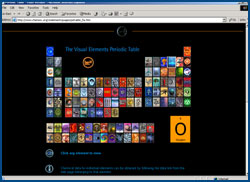 |  Ways
of organizing and presenting scientific information continue to evolve,
as can be seen in the Royal Chemical Society's Visual Elements Periodic
Table. Ways
of organizing and presenting scientific information continue to evolve,
as can be seen in the Royal Chemical Society's Visual Elements Periodic
Table. |
The
first scientific articles are typically brief reports (seldom more than
10 pages, sometimes a single paragraph) describing an individual's
encounter with nature through observation and experiment. Particularly
in England, they tend to be a run of Baconian "facts" woven into a
narrative loosely connected, if at all, with an explanatory theory. In
general, they seek to establish credibility by means of reliable
testimony more than painstaking technical details, and by qualitative
experience more than quantitative experiment and observation in support
of theory. The early articles also largely rely on everyday language
and are written in a style conforming to the compositional norms of
expository prose generally, not norms specific to science. For the most
part, the targeted audience is a loosely knit community of amateurs and
professionals united by a curiosity about how nature works. The modern
scientific article, in contrast, has evolved a specialized language and
prose style adapted for efficient communication to other professionals
engaged in similar research. The impersonal style of these articles is
designed to focus the reader's mind on the things of the laboratory and
the natural world, rather than to draw attention to the text itself or
its author. Presentational features
The
presentational features of the scientific article have evolved in two
primary ways. First is development of a more uniform and regimented
arrangement of the article's overall content. This arrangement
represents a tribute to the efficacy of the scientific method as a
means of exploring nature. To that end, the modern scientific article
is typically divided into an introduction, which places readers in the scientific context in which its authors are working, a section on methods and materials that outlines the procedures used, a section on results that displays the data generated and the intellectual context of their acquisition, a discussion section that interprets the data and addresses future research that would extend the present insights, and a conclusion that reiterates the central argument in a single paragraph or two and brings the main body to a close.
The
scientific article has also evolved a master finding and organizing
system. This system compartmentalizes the essential features in
articles through the use of summaries and abstracts, headings and
subheadings, tables and figures integrated into the text, citations
that supply context for statements at any point in the text, and so
forth. This system permits scientists to read articles
opportunistically rather than sequentially, scanning the various
sections in search of useful bits of method, theory, and fact.
The
latter half of the twentieth century has seen a great flowering of
scientific style guides and manuals, which have codified presentational
as well as stylistic features in the scientific article and contributed
to its growing uniformity across national boundaries and disciplines. Visual displays
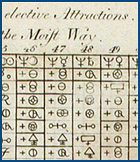 | | University of Chicago Special Collections Research Center | | Torbern Bergman's table was an early attempt to represent chemical equations. |
At
the origin of the scientific article in 1665, several types of visual
representation had already reached maturity: tables of data had long
been a staple of the astronomical literature; three-dimensional
drawings of anatomical features had attained a high level of technical
detail and artistry, as shown by the graphics in the work of Vesalius
and Leonardo da Vinci; map making of the earth and heavens was a
long-standing enterprise; and geometric diagrams had been around since
Euclid. Moreover, illustrations of flora and fauna, as in Hooke's Micrographia,
were on a par with anything produced by graphic artists today.
Nonetheless, illustrations and tables are relatively scarce into the
nineteenth centuries, in part because of the expense involved in
reproduction. It is not uncommon to find, for example, all the
illustrations for an annual volume of a journal isolated in a slim
section at the end. The graph, invented in the late eighteenth century,
revealed the power of visualizations for conveying masses of data at a
glance and uncovering data trends. In the nineteenth and twentieth
centuries, scientists have invented many other new forms of scientific
visualization, some of them requiring highly specialized decoding
abilities on the part of the intended audience. Because of their
utility for creating and communicating science, combined with advances
in photographic reproduction and computer technology, visual
representations now play a central role in the scientific article. The languages of science
English,
French and Latin were the dominant languages of the scientific article
in the seventeenth and eighteenth centuries. Despite the important
contributions by natural philosophers throughout Europe, the fact
remains that the work by investigators in countries like Italy, Spain,
Denmark, Russia, and Sweden, though often published in their respective
vernaculars, was usually communicated to Europe, and to the world, in
one of the three major languages of science. Moreover, the two centers
of scientific activity during this early period, England and France,
greatly preferred publication in the vernacular over Latin, reflecting
"a decisive switch from dry and bloodless scholastic erudition toward a
mixed scientific/technological literature based upon the experience of
the artisan, the practitioner, the traveler" (H. Floris Cohen, The Scientific Revolution: A Historiographical Inquiry,
1994). With the emergence of the German states as a center of
eighteenth-century research, German became a major language of science
along with English and French. In
the twentieth century, as science has become a global phenomenon,
scientific articles in Chinese, Japanese, and Russian also have become
prominent. Nonetheless, at no other time in the long history of the
scientific article has one language, what the linguist M. A. K.
Halliday aptly calls "scientific English," so dominated this genre. The
most-significant journals of science, whatever their nationality, now
publish in English. Even the French Académie des Sciences in its Comptes rendus
has turned to publishing summaries and whole articles in English. It is
no accident that, when the National Research Council of Japan launched
several new specialized journals in the 1920s, they chose English to
reach the widest possible international audience. What's next? Now,
in the 20th century, we look forward to applying electronic technology
to scientific communication. Certainly the editors and scientists who
started this whole process more than 300 years ago would be astounded
at the scope of the worldwide scientific endeavor. But I doubt that
they would have any difficulty recognizing the basically similar
characteristics of the system they started. --Eugene Garfield
Current Contents (February 25, 1980)  | | Founded in 1895, The Astrophysical Journal now publishes an electronic edition that provides articles in HTML and PDF formats. |
The
scientific article is in the midst of a radical transformation spurred
by advances in computer technology, in particular, word processing and
graphics software, electronic mail, and the World Wide Web. This
technology is changing the way in which the scientific manuscript is
prepared by authors, put through peer review, produced in final form,
distributed to interested readers, and perused by those readers. At the
research fronts of fast-moving fields like particle physics, this shift
is well on its way: scientific articles published in hardcopy
periodicals are already yesterday's news. The next century, what Steven
Harnad calls the "post-Gutenberg era," may very well witness the
extinction of the original scientific "paper" appearing on paper. And
the long-term effect of electronic preparation and publication of
manuscripts may be as profound as when the scientific article evolved
from scholarly letter writing and books in the seventeenth century. | | Nature posted the results of the International Human Genome Sequencing Consortium online, free to the public. |
Take,
for example, the initial results of the International Human Genome
Sequencing Consortium, posted online in February 2001. For publication
of this instant classic, Nature magazine suspended its usual
practice of allowing only subscribers access to its electronic
contents, and released it to the public. We suspect this article holds
the record for the longest ever published by Nature magazine
(62 pages), where articles seldom exceed four or five pages. Its
decoding of the 3.2 billion letters in the DNA of the human genome is
the work of 20 laboratories and more than 250 scientists and computer
experts around the world. The consortium's most surprising finding
(though very tentative) was that the human genome has 30,000-40,000
protein-encoding genes--a far cry from the more than 100,000 previously
estimated. Indeed, this number is not all that much higher than less
complex forms of life like fruit flies (13,000), microscopic round
worms (19,000), and mustard weeds (26,000). This
long article ends by echoing the first sentence in the next to last
paragraph of Watson and Crick's famous DNA article from the 1953 issue
of Nature: "Finally, it is has not escaped our notice that the
more we learn about the human genome, the more there is to explore"
(italics indicate repetition of wording between the two articles). That
sentence is followed by an apt quotation from T. S. Eliot's "Four
Quartets": We shall not cease from exploration.
And the end of all our exploring
Will be to arrive where we started,
And know the place for the first time. |