How Do Families Make a Difference? Unraveling a Chain of
Influences
Some kids from an inner-city neighborhood make it
successfully to adulthood and some don't. What are the influences
that determine whether an inner-city youth makes it successfully to
adulthood?
There is no magic influence, characteristic, or strategy that
will make for a successful youth. Social influences, parental
resources, family processes and family management strategies all
play a part in determining how adolescents develop.
Frank Furstenberg and his colleagues have studied inner-city
Philadelphia neighborhoods in order to try to understand why some
kids from disadvantaged neighborhoods are successful while others
aren't.
Looking at Chains of Influence
Furstenberg and his
colleagues try to understand what they call "chains of influence" in
order to explain the outcome of adolescent development. In short,
they try to untangle the complex ways that different social,
parental and family characteristics affect a child's outcome.
They try to unravel the mystery of youth outcomes by looking
at how one set of things will affect another set of things which
will, in turn affect other things, and so on, until they can
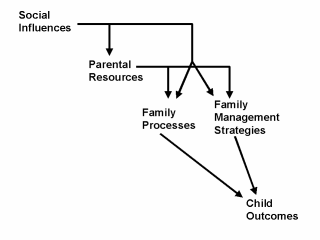
understand the outcomes of adolescent development. The chain of
influence that the authors use to understand adolescent outcomes is
presented in Figure 1.
Figure 1: Chain of Influences On Adolescent Development
Outcomes
How do
these relationships actually affect child outcomes? The authors look
at this complex relationship one step at a time.
The Connection Between Social Influences and Parental
Resources
The authors look at three kinds parental resources:
- Parental efficacy: the extent to which parents think
that they are making a difference in the lives of their children.
- Resourcefulness: how confident a parent is that they
can recover from a setback.
- Mental Health Problems: feelings of depression,
exhaustion, and anxiety.
Note: a blank cell indicates that
there is no relationship.
|
Parental
Efficacy |
Resourcefulness |
Mental Health
Problems |
| Family Income |
-- |
-- |
-- |
| Welfare
Dependence |
-- |
-- |
-- |
| Education of
parent |
-- |
Weak
relationship:
More educated
parents tend to feel more resourceful |
-- |
| Household
size |
-- |
-- |
-- |
| Race |
-- |
-- |
-- |
| Single parent |
Weak
relationship:
Single parents
tend to feel less effective |
-- |
Weak
relationship:
Single parents
tend to report more mental health problems |
| Weak marriage |
Weak
relationship:
A weak marriage
makes parents tend to feel less effective |
Weak
relationship:
A weak marriage
makes parents tend to feel less resourceful |
Weak
relationship:
Parents in weak
marriages tend to report more mental health problems |
| Age of
caregiver |
Weak
relationship:
Younger
caregivers tend to feel less effective |
Weak
relationship:
Younger
caregivers tend to feel less resourceful |
Weak
relationship:
Younger
caregivers tend to report more mental health
problems |
|
Age of child |
Weak
relationship:
Parents of
younger children tend to feel less effective |
-- |
-- |
|
Gender of child |
Weak
relationship:
Parents of boys
tend to feel less effective than parents of girls |
Weak
relationship:
Parents of
girls tend to feel less resourceful than parents of
boys |
-- |
Connection Between Social Influences, Parental Resources and
Family Processes
How are social influences and parental
resources then related to family processes? The authors report the
following relationships.
Note: a blank cell indicates that there is no relationship
and only the social influences that were found to have an effect are
reported.
| |
Support for
Autonomy |
Discipline
Effectiveness |
Positive Family
Climate |
|
Parental Resources |
|
|
|
| Efficacy |
Weak
relationship:
effective
parents tend to support autonomy in their child more
often |
Weak
relationship:
effective
parents tend to be more effective in disciplining their
child |
Weak
relationship:
effective
parents tend to have a more positive family
environment |
| Resourcefulness |
Moderate
relationship:
resourceful
parents tend to support autonomy in their child more
often |
-- |
Moderate
relationship:
resourceful
parents tend to have a more positive family
environment |
| Mental health problems |
Weak
relationship:
parents who
report mental health problems tend to support autonomy in
their child less often |
Weak
relationship:
parents who
report mental health problems tend to be less effective in
disciplining their child |
Weak
relationship:
parents who
report mental health problems tend to have a less positive
family environment |
|
Social Influences |
|
|
|
| Welfare dependence |
Weak
relationship:
welfare
dependent families tend to support autonomy in their child
less often |
-- |
-- |
| Household size |
-- |
-- |
Weak
relationship:
larger families
tend to have a less positive family environment |
| Race |
-- |
Weak
relationship:
African
American parents tend to be more effective in disciplining
their children than white parents |
-- |
| Single parent |
-- |
-- |
Weak
relationship:
single parent
families tend to have a less positive family
environment |
| Weak marriage |
-- |
-- |
Weak
relationship:
families with
weak marriages tend to have a less positive family
environment |
|
Controls |
|
|
|
| Age of child |
-- |
-- |
-- |
| Gender of child |
-- |
-- |
-- |
Connection Between Social Influences, Parental Resources and
Family Management Strategies
How are social influences and
parental resources then related to family management strategies? The
authors report the following relationships.
Note: a blank cell indicates that there is no relationship
and only the social influences that were found to have an effect are
reported.
| |
Parental Institutional
Connections |
Parental Investment in
Child's Activities |
|
Parental Resources |
|
|
| Efficacy |
Weak
relationship:
effective
parents tend to have more institutional connections |
Weak
relationship:
effective
parents tend to be more invested in their child's
activities |
| Resourcefulness |
-- |
Weak
relationship:
resourceful
parents tend to be more invested in their child's
activities |
| Mental health problems |
-- |
-- |
|
Social Influences |
|
|
| Family Income |
Weak
relationship:
families with
higher incomes tend to have more institutional
connections |
-- |
| Education of caregiver |
Weak relationship:
families with a more educated caregiver tend to
have more institutional connections |
-- |
| Household size |
Weak relationship:
larger families tend to have a less institutional
connections |
Weak relationship:
parents in larger families tend to be less invested
in their children's activities |
| Race |
Weak
relationship:
African
American parents tend to have more institutional
connections |
Weak
relationship:
African
American parents tend to be more invested in their children's
activities |
|
Controls |
|
|
| Age of child |
Weak relationship:
Parents of older children tend to have more
institutional connections |
Weak relationship:
Parents of older children tend to be more invested
in their children's activities |
| Gender of child |
-- |
-- |
The Bottom Line
It will doubtless surprise no one that
Furstenberg and his colleagues find that families have important
impacts on the outcomes of their children's lives. What is
surprising, however, is just how families impact their children's
lives. Three points jump out:
-
No single parental action or family
characteristic ensure a child's success.
-
Different family characteristics
and parental management strategies make differences in different
areas of their children's lives.
-
The relationship between social
environment, parental resources, family processes and family
management strategies is complex.
- Research Design:
-
Research Problem
Discover the pathways that link neighborhoods, families and the
developmental course of children.
Research Questions:
How do neighborhoods and families interact in their affects on
the development of adolescents?
Method
This study was carried out in two parts:
- a smaller ethnographic study that focused on a small number
of families within 5 Philadelphia neighborhoods;
- a larger survey interview study that focused on families
with target age children from a sample of 65 census tracts from
4 large sections of Philadelphia.
Participants
For the ethnographic study, 35 families with target age
children were selected from the target neighborhoods. Repeated
interviews were carried out with family members.
For the survey study, a sample of households in the identified
census tracks were screened. 805 potentially eligible families
were identified (in which a youth between the ages of 10 and 14
resided with a biological or surrogate parent). Of these, 482
parent and teen pairs participated in the study.
Characteristics of Persons in all Philadelphia Tracts, Study
Tracts, and Study Participants
|
Persons in all Philadelphia
tracts (%) |
Persons in all tracts in
the study (%) |
Persons participating in
the study (%) |
| African American |
39 |
61 |
64 |
| White |
52 |
31 |
31 |
| Below Poverty |
16 |
24 |
not calculated |
| High school graduate |
63 |
57 |
70 |
| College graduate |
15 |
9 |
9 |
Instruments and Procedures
For the survey study, the authors were concerned that
contacting participants via phone would bias the sample away from
the very poorest families (who did not have phones). They randomly
selected a sample drawn from 900 household addresses with unlisted
or no phones. They then screened those addresses in person and
identified 61 households eligible for the study. They conducted
interviews with 47 of those households.
Comparing these households with the households contacted by
phone, the authors confirmed their suspicions that the phone
screening resulted in an underrepresentation of the most
disadvantaged households.
Funding Institution
John D. and Catherine T. MacArthur Foundation.
Citation: This Keytext reports some
of the ideas and findings from the following
source:
Furstenberg, F. F., Jr, Cook, T. D., Eccles, J., Elder,
G. H., Jr., & Sameroff, A. (1999). Managing to make it: Urban
families and adolescent success. Chicago: University of
Chicago Press. Pp. 120-127, 253-254
To see other key texts
that originated from this same citation, click here.
Authors:Thomas D. Cook Jacquelynne S Eccles Glen J. Elder, Jr. Frank F. Furstenberg Jr. Arnold Sameroff