Source Area 7
Remedial Investigation Results
Southeast Rockford Groundwater Contamination Superfund
Project
February 2001
Rockford, Illinois
 Background. Illinois Environmental Protection
Agency (Illinois EPA) investigations beginning in 1991 identified Area 7
as one of four major sources of groundwater (water beneath ground surface)
contamination in the Southeast Rockford Groundwater Contamination
Superfund project. In 1996, Illinois EPA conducted more extensive
environmental investigations in the four major source areas in preparation
for developing remedies for each of the areas. Background. Illinois Environmental Protection
Agency (Illinois EPA) investigations beginning in 1991 identified Area 7
as one of four major sources of groundwater (water beneath ground surface)
contamination in the Southeast Rockford Groundwater Contamination
Superfund project. In 1996, Illinois EPA conducted more extensive
environmental investigations in the four major source areas in preparation
for developing remedies for each of the areas.
Summary of Source Area 7 investigation results. Area 7 is a
former unregulated disposal area evidently used for both household and
industrial waste. Early aerial photographs of Area 7 show evidence of
waste disposal and excavation from 1959 through 1970. The area, located
north of Balsam Lane in Rockford, now contains a field, wooded areas and
Ekberg Park. The depth of contamination varies from four feet below ground
surface to at least 29 feet. Illinois EPA estimates that there are
approximately 265,000 cubic yards of highly contaminated soil beneath the
ground surface.
Illinois EPA soil borings show sands, silts and clay to bedrock.
Bedrock varies between 35 and 135 feet below ground surface. The water
table varies from 36 feet below ground surface south of the park, to 13
feet in the park and 2 feet near the creek. The groundwater flows to the
northwest.
How was the area discovered? In 1991, Illinois EPA installed a
monitoring well in Area 7 as part of a study to determine the source of
private well contamination west of 20th Street. At the time of
installation, it was thought that the Area 7 well was probably a
"background" well. A background well is one installed in an uncontaminated
area to be used for comparison to wells in contaminated areas. Groundwater
samples in 1991, however, showed that the Area 7 well contained high
levels of the same contaminants found in the private wells west of 20th
Street. The Illinois EPA investigations since 1991 have confirmed that the
area is a major source of groundwater contamination.
The main chemicals of concern. The main chemicals of concern in
Area 7 are industrial solvents. The solvents are in a class of chemicals
called volatile organic compounds (VOCs). They are called volatile because
they vaporize (evaporate) rapidly and organic because they contain carbon.
Chemicals of concern include 1,1,1-trichloroethane (TCA),
trichloroethylene (TCE), perchloroethylene (PCE) and xylene. These
chemicals are often found at lower concentrations in household products
such as glues and solvents. Xylene and other compounds detected in Area 7
are also associated with petroleum products. Results for different media
(soil, groundwater, etc.) are summarized below.
Surface Soil
No contaminants were detected at levels of concern in surface samples
(0 to 6 inches). At 6 to 12 inches, there were samples that exceeded
screening levels for VOCs, two semi-volatiles and two metals. The Illinois
EPA evaluation determined that none of these samples, however, had
contaminants present at levels of concern for people using the park.
Subsurface Soil
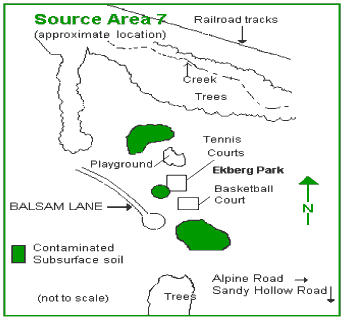
Illinois EPA sample results showed three subsurface soil "hot spots" as
shown on the map on page 1. The VOCs found most often were TCA, PCE and
TCE. These chemicals and others were found at concentrations substantially
higher than cleanup objectives proposed for the area.
South of the basketball court. Illinois EPA samples
south of the basketball court showed elevated levels between four and 28
feet beneath ground surface. A sample four feet beneath ground surface
had 441 parts per million (ppm) total VOCs. A sample 15 feet beneath
ground surface showed 1,019 ppm total VOCs, and a sample 20 feet below
ground surface had 357 ppm total VOCs.
North of the playground. Tests in this area showed
significant contamination from 3 to at least 28 feet below ground
surface. Testing was not performed below 28 feet because of the risk of
spreading the contamination deeper into the groundwater. Illinois EPA
samples showed 627 ppm total VOCs at 4 feet below ground surface, 17 ppm
at 11 feet below ground surface and 875 ppm at 25 feet below ground
surface.
West of the tennis court. Illinois EPA samples showed
35 ppm total VOCs 20 feet below ground surface. Notable contamination
was found between 19 to 23 feet below ground surface.
Test Pits
In June 1993, three test pits (large holes dug for investigation
purposes) were excavated in Area 7 to a depth of 15 feet. The test pits
revealed metal cans, glass bottles and miscellaneous trash. Soil samples
showed PCE up to 22 ppm, TCA up to 4 ppm and TCE up to 3 ppm.
Groundwater
Illinois EPA sample results showed high levels of solvents in the
groundwater with TCA up to 8,000 parts per billion (ppb). The drinking
water standard for TCA is 200 ppb. Area residents who are using
Rockford Public Water Supply, however, do not have to worry about the
safety of their drinking water, because the Rockford Water Supply is
regularly tested for possible contaminants. Water that violates U.S.
Environmental Protection Agency (U.S. EPA) drinking water standards is not
distributed to the public.
Non-Aqueous Phase Liquid (Free Product)
Chemicals in water that are present in high enough concentrations to be
undissolved in the water are called free product or non-aqueous phase
liquid (NAPL). NAPL is of special concern, because it is concentrated and
continually releases contaminants into the groundwater and into the air
pockets in the soil above the groundwater. Chemicals, such as PCE, that
are heavier than water will sink to the bottom of the water table and are
called dense NAPL or DNAPL. Chemicals, such as xylene, that are lighter
than water will float on water table and are called light NAPL or
LNAPL.
Illinois EPA sample results indicate that there may be DNAPL in the
area south of the basketball court. Other volatiles, which are lighter
than water such as xylene, were also found in high concentrations in this
area and may be floating on top of the water table (LNAPL). Sample results
also indicate DNAPL is present in the area by the playground.
Soil Gas
Since VOCs evaporate (vaporize) readily, vapors from subsurface
contamination can accumulate in the air pockets between soil particles
beneath ground surface. The air and vapors found in these air pockets are
called soil gas. In 1992, 1993 and 1996, the Illinois EPA conducted soil
gas surveys of Area 7 by driving probes into the ground, withdrawing the
air that accumulated in the air pockets (soil gas) and analyzing the air
for VOCs. Results showed high levels of three VOCs in soil gas north of
the playground and south of the basketball court. The three VOCs were TCA,
PCE and TCE-all of which are industrial solvents.
The Illinois Department of Public Health (IDPH) evaluated air samples
taken above ground in the park and concluded that VOCs detected in the
above ground outdoor air were similar to levels found in an average urban
community and were not a concern for people using the park.
The IDPH and the Illinois EPA tested the basement air in several homes
around Area 7 in 1992 and 1993. IDPH concluded that the concentrations
detected in basements near Area 7 were below levels of health concern.
Since many of these chemicals are found in household products such as
paints and glue, the source of detected levels could not be determined.
The U.S. EPA and Illinois EPA plan to repeat sampling of several homes
near Area 7 during the design phase of the remedy-probably in 2001. These
tests will make sure that levels have not increased and will provide data
for U.S. EPA to compare to guidelines they are currently using.
Creek Sediments and Water
In 1996 and 1998, Illinois EPA collected surface water and sediment
samples from an unnamed creek at the north end of Area 7.
The surface water samples showed low concentrations of VOCs at levels
below U.S. EPA drinking water standards. Lead and antimony concentrations
slightly exceeded concentrations set to protect people over a lifetime
of exposure, drinking two liters of water every day. Lead and antimony
are not among the main contaminants of concern in other parts of Area
7.
Sediment samples contained one VOC, 1,2-dichloropropane, which is not a
common VOC found in other parts of Area 7. Sediment samples also contained
semi-volatiles (such as fluoranthene, pyrene, benzo (a) anthracene,
chrysene) that are often found in petroleum products but are not the main
chemicals of concern in other parts of Area 7.
The Illinois EPA and U.S. EPA determined that it would be more
efficient to further evaluate the creek running north of Area 7 during the
design phase of the project. The design phase will likely occur in 2001.
If that investigation identifies the need for remediation in addition to
that outlined within the plan currently being proposed, the remedy would
be appropriately altered. The public will be notified of this alteration.
Depending upon the significance of the change in remedy, the agencies may
be required to hold additional public meetings and allow public comment on
the additional remedy.
Next Steps. The Illinois EPA and U. S. EPA have proposed a plan
to remedy Area 7 as well as the other three major sources of contamination
for this project. For more information on all the remedies studied for
Area 7 and the Area 7 proposed plan, see the enclosed feasibility
study/proposed plan fact sheet. You may also obtain more information from
sources listed below.
For More Information:
Contacts: For more information about the project including fact
sheets on the remedial investigation results, feasibility studies and
proposed plans for each of the four major source areas, you may contact
the Illinois EPA staff listed below:
Virginia
Wood
Community Relations Coord.
Illinois EPA
1021 N.
Grand Ave. E.
Box 19276
Springfield, Illinois
62794-9276
Phone: 217-785-1269 |
Jerry
Willman
Project Manager
Illinois EPA
1021 N. Grand Ave.
E.
Box 19276
Springfield, Illinois 62794-9276
Phone:
217-524-6365 |
Repositories: Full reports for the project may be reviewed at
the following locations.
|
Rock River Branch
Rockford Public Library
3128 S.
11th Street
Rockford, IL
61109
815-398-7514
(Call for hours)
|
Ken-Rock Community Center
3218 S. 11th
Street
Rockford, IL 61109
815-398-8864
(Call for hours)
|
Administrative record file: The administrative record file is
located at the Illinois EPA headquarters in Springfield, Illinois. Call
217-782-9878 for an appointment. The administrative record file will also
be located on microfiche at the Main Branch of the Rockford Public Library
at 215 N. Wyman in Rockford. |