

| /index /feature | Home | Updates | News | About |
|
| |
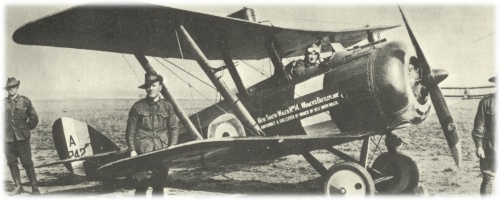
Twenty Five Days Over Cambrai

2 Squadron Australian Flying Corps Battle As Told in the Royal Flying Corps Communiques
Communique No.115, 20 - 26 November 1917 : During the period under review (20th to 26th September inclusive) the weather has been very bad for flying. In air fighting ten EA have been brought down and six driven down out of control, and an enemy balloon shot down in flames. 52,673 rounds have been fired at ground targets.
The year of 1917 was to mark a series of Offensives in the British Line. In November General Byng attacked the Hindenburg Line at Cambrai. The offensive was most notable for using the new technology of Tanks to break the trenches deadlock.
Communique No.115, November 20 : On the 20th low clouds and mist again made aerial work very difficult, but quite a considerable amount was carried out on account of the attack by the First and Third Armies south of Cambrai.
Communique No.115, November 20, 68 Squadron : Lt H Taylor while engaging troops at 30 feet, had his machine hit, so landed in "No Mans Land". On crawling out of his machine he was fired at by German snipers, so took up a German rifle with which he fired at the enemy and then crawled back. On the way he picked up a wounded man and carried him until reaching one of our patrols. He then found another British machine which had landed owing to it's pilot being wounded, so he got in it and tried to fly off, but could not start it. 2nd Lt F Huxley dropped bombs on a gun and horses, obtaining a direct hit. He also obtained a direct hit on a G.S Wagon which was destroyed and two personnel killed, then attacked 300 troops marching in fours and shot about 14 of them.
The British Administration referred to 2 Sqn AFC in their bookkeeping as 68 Sqn AFC. After the Australian Government protested the British Administration finally aligned their bookeeping to the Australian Imperial Force nomenclature for the Australian Flying Corps.
The DH5 Taylor tried to start and fly back to his base was the DH5 of Captain J Bell who had been shot through the chest by rifle fire from the ground during an attack with Lieutenant R.W. McKenzie. Bell later died of his wounds. Greater detail of Lieutenant H Taylor's episode is contained in Harry Taylor's Battle of Cambrai.
Lieutenant F.G. Huxley later wrote of his attack on the 300 infantrymen, "This parade was dismissed quicker than parade was ever before." Lieutenant L.H. Holden brought his aircraft in at an advanced landing field a wreck, the only part of man and aeroplane not holed was Holden's skin. Holdens clothes alone had taken three bullets. The Intelligence Summary describing the state of Holdens DH5 and clothes is on the Lieutenant L.H. Holdens DH5 profile.
Communique No.115, November 21 : Practically no work was done owing to rain and low clouds.
Communique No.115, November 22 : Low clouds and thick ground mist again considerably hindered aerial work. In spite of the the weather, machines went out in order to interfere with the enemy's movements and to gain information. In all 32 successful reconnaissances were carried out, gaining valuable information.
Communique No.115, November 22, 68 Squadron : Lt F Huxley dropped two 25 lb bombs on enemy in close formation and obtained direct hits, Capt R C Phillipps fired 300 rounds at gun crews, then dropped bombs which fell in the middle of the machine gun crew. After this he attacked transport. Lts R W Howard and A Griggs also dropped bombs and fired at troops.
Communique No.115, November 22, Enemy Aircraft : Lt F Huxley, 68 Squadron destroyed an EA scout.
Lieutenant F.G. Huxley's victory over an Albatros Scout was the squadrons first. Huxley later wrote, "It was a gift.", having dispatched it at fifty feet and 30 rounds. Lieutenant R.W. Howard of 2 Sqn AFC shot down a DFW near Graincourt for his first victory. Captain R.C. Phillipps also of 2 Sqn AFC scored his first of 15 victories on this day, shooting down a DFW. Both enemy aircraft shot down by Howard and Phillipps were captured behind British lines.
2 Squadron AFC suffered three casualties on the 22nd, Lieutenant A.J. Pratt, Lieutenant A Griggs and Lieutenant D.G. Clark were all shot down by ground fire. Griggs and Clark were both mortally wounded and later died of wounds. Griggs was one of a number of Americans in the AFC. Griggs was born in Meridian, Mississippi, U.S.A. Another 2 Sqn pilot, Lieutenant L.N. Ward was shot down behind enemy lines and taken POW.
Major General Trenchard, commander of the RFC visited the squadron on the 22nd of November and wrote General Birdwood who commanded the ANZAC Corps, "I have just been to see the Australian fighting squadron No. 68 [No.2 Sqn Australian Flying Corps] for the second time in the last week, and I have talked to some of the pilots who carried out the great work on November 20th, 21st and to-day. Their work was really magnificent ...... These pilots came down low and fairly strafed the Hun. They bombed him and attacked him with machine gun fire from fifty feet, flying among the treetops; they apparently revelled in this work, which was of great value. You might like to let some of your people know that I think them really great men, and I am certain that in the summer next year they will all give a very fine account of themselves. They are splendid."
Communique No.115, November 23 : Lt F Huxley, 68 Squadron saw three tanks held up in Bourlon Wood so dropped four bombs from 100 feet, one by one, upon two anti tank guns which were holding them up. The guns were silenced and the tanks then advanced into the wood. He then saw a strong point preventing the advance of our infantry, so dived on a number of occasions and fired 545 rounds. This caused great confusion and so assisted in the taking of the strong point which soon occurred.
Lieutenant S.W. Ayers was shot down by ground fire and died of the wounds suffered. Lieutenant L.H. Holden again brought his aircraft in a wreck. Bourlon Wood and Fontaine had been reported as taken with pilots of 2 Sqn AFC having seen the British tanks advancing from Fontaine to Cambrai. The Allied offensive petered out over the next two days as General Byng had no reserves left and Cambrai was never reached.
Communique No.115, November 24 : A little flying was done up until 11am, after which it was impossible owing to a gale.
Communique No.115, November 25 : A strong west wind and low clouds made work almost impossible.
Communique No.115, November 26, Enemy Aircraft : Lt H Taylor, 68 Squadron, shot down a two seater EA which crashed into the ground.
Lieutenant H Taylor was patrolling Bourlon Wood at 1545 ft when he attacked a DFW at the same height. The DFW flew straight into the ground, in Taylor's words, "where it stopped dead, without any run and with no signs of life."
Communique No.116, 27 - 3 December 1917 : During the month of November 49 EA were brought down and 37 were driven down out of control, 55 1/2 tonnes of bombs were dropped, and 5450 photographs taken, while 177,000 rounds were fired from low altitudes at ground targets. The weather throughout the month was bad for flying and most of the work done at extraordinary low altitude.
Communique No.116, 27 November 1917 : No mention.
Communique No.116, 28 November 1917 : No mention.
Communique No.116, 29 November 1917 : No mention.
Lieutenant R.W. Howard fought with a DFW, wounding the observer, but the DFW escaped with it's superior speed and landed.
Communique No.116, 30 November 1917, Enemy Aircraft : Capt G C Wilson, 68 AFC, was engaging one EA when he was attacked by another, so turned, got underneath this EA and shot him out down out of control, and saw it crash on landing, so then dropped a bomb which exploded right on the EA. He had expended all his ammunition in firing at ground targets and at this EA, and when flying towards the lines was cut off by two EA, so manoeuvred and pretended to attack the EA who flew away.
Communique No.116, 1 December 1917, Enemy Aircraft : Enemy aircraft activity was slight and only five combats took place. Lt F G Huxley, 68 Squadron AFC, shot down an EA which crashed, and Lt R W McKenzie in the same squadron drove down an EA which attempted to land but ran into a shell hole.
The German counter offensive had taken the southern part of the salient and Fontaine and Bourlon Wood were lost to the Allies as they evacuated their positions.
Lieutenant H Taylor, Lieutenant L Benjamin and Lieutenant W.A. Robertson had their DH5 machines so damaged by ground fire they were forced to land at advanced landing grounds. Lieutenant Forrest attacked a German three-seater, thought to be a Gotha over the front lines. The three seater was escorted by five scouts and firing into British trenches. Forrest's attack was unsuccessful. McKenzie shot down one of the escorting Albatros Scouts.
Communique No.116, 2 December 1917 : Squalls and very strong wind prevented much flying being done.
Communique No.116, 3 December 1917 : EA was below normal except on the Third Army front where it was great.
Communique No.117, 4 December 1917 : Weather was fine but thick ground mist, and in the 2nd Brigade area snow prevented our machines from working freely.
The British Line withdraws to South of Bourlon Wood, the Cambrai battle is over. 2 Sqn AFC falls back into their normal patrol patterns
Communique No.117, 5 December 1917 : No mention.
While about to attack the German aerodrome at Awoingt, seven DH5's attacked a German formation of twelve Albatros Scouts and four two seaters. Two DH5's drop out with stoppages and another with engine trouble. The Germans did not press the attack.
Communique No.117, 6 December 1917, Enemy Aircraft : Lt F G Huxley, 68 Squadron AFC, was flying at 2000 ft when he saw two two seaters below him, so he dived and shot one down in flames.
The German Army again attacked at Fontaine with 2 Sqn bombing and strafing their advanced troops. This was the last day of operations with their Airco DH5 aircraft. The squadron began the change over to SE5a aircraft over the next week.
Communique No.117, 7 December 1917 : Low clouds prevented much flying during the day.
Communique No.117, 8 December 1917 : Little flying was possible due to unfavourable weather until the afternoon.
Communique No.117, 9 December 1917 : On the 9th instant practically no work was done in the air owing to the weather.
Communique No.117, 10 December 1917 : No mention.
Communique No.117, 11 December 1917 : Enemy aircraft were inactive and no combats took place.
Communique No.118, 12 December 1917 : No mention.
Communique No.118, 13 December 1917 : Low clouds and ground mist made work in the air impossible. Enemy aircraft were inactive and no combats took place.
Communique No.118, 14 December 1917 : Practically no work was possible owing to low clouds, mist and rain.
Communique No.118, 15 December 1917, Honours and Awards : Military Cross - Capt G C Wilson, Capt R C Phillipps, Lt F G Huxley, Lt R W Howard, Lt L H Holden, Lt H Taylor.
Of the 19 Military Cross awardings mentioned in the Communique, 6 were awarded to pilots from 2 Sqn AFC.
www.australianflyingcorps.org : A Complete History of the Australian Flying Corps